
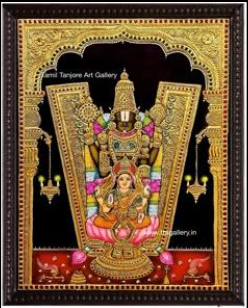
Tanjore or Thanjavur paintings are a classical South Indian art form originating from the town of Thanjavur, Tamil Nadu, India. Tanjore paintings are also known as “Palagi Padam” which translates to “a picture on a wooden plank” as these paintings were created on wooden planks. They are also distinguished by elaborate depictions of Hindu deities, adorned with glittering golden foil, semi-precious stones, and vibrant colours on a raised, three-dimensional surface. The primary themes depicted in Tanjore paintings revolve around Hindu deities and narratives from epic sagas such as the Ramayana and the Mahabharata. Renowned for their innovative painting style, exquisite portrayal of devotion, cultural festivities, and spirituality, Tanjore paintings have garnered global acclaim.
HISTORY OF TANJORE PAINTINGS:
The historical roots of Tanjore painting can be traced back to the Chola and Nayak dynasties. These paintings served as decorative elements for the walls of temples, residences, and palaces. While temple and residential paintings depicted Hindu deities and religious themes and narratives, palace paintings showcased coronations and battle triumphs. The remnants of these paintings can still be observed in temples located in Hampi, Andhra Pradesh, and Thanjavur.
The Vijayanagar empire of the 16th Century had an important influence on Tanjore Paintings, primarily through the migration of Telugu speaking artists, particularly the Raju and Naidu communities from Andhra region to Tamil Nadu. After the fall of the Vijayanagar empire in the Battle of Talikota, many of these artists who depended on patronage of the rulers, migrated to Thanjuvar and Madurai. They brought their established techniques, themes and styles along with them which established the groundwork for what would become Tanjore or Thanjuvar paintings. The migrant artists were supported by the Nayaka governors which ensured that the Vijayanagar artistic tradition could be preserved and promoted.
Tanjore art experienced significant flourishing and evolution during the reign of the Marathas, who captured Thanjuvar in 1676 CE. Maharaja Serfoji II (1777-1832 CE) and other Maratha rulers were prominent patrons of the arts, whose contributions have left an indelible mark on the distinctive characteristics that define Tanjore paintings to this day. The Maratha rulers were particularly interested in showcasing the grandeur and divine majesty of their kingdom, which prompted them to encourage artists to adopt an ornate and lavish style of art. They introduced the use of extensive gold foil, semi-precious gems, glass beads to give the paintings their characteristics.
Tanjore paintings initially centred on Hindu deities under the patronage of the Nayaka rulers. However, the Marathas significantly expanded the artistic scope by encouraging artists to depict Maratha rulers, courtiers, and nobility, adorning the palace walls with these creations. These paintings incorporated elements such as curtains, chairs, and tables, which subtly drew influences from European art. Additionally, the artists introduced more narrative elements and lifelike figures, influenced by Persian and Mughal styles, as well as incorporating stories of Hindu deities and goddesses. These innovations and the fusion of Tamil artistic elements with various other influences, such as European and Vijayanagara, elevated the style of Tanjore paintings, contributing to its global recognition.
Despite the conclusion of Maratha rule and the dominance of the East India Company, Tanjore art maintained its enduring popularity. Following the Anglo-Mysore War, the East India Company settled in Thanjavur and still fostered significant patronage for Tanjore painting styles.
LEGACY
The enduring legacy of Tanjore Paintings stands as a testament to the rich South Indian art style. Renowned for its distinctive fusion of devotion, grandeur, and intricate craftsmanship, Tanjore paintings continue to captivate audiences worldwide. Their enduring appeal lies in their ability to infuse homes with harmony, divine grace, and positivity. Beyond their aesthetic value, Tanjore paintings have become highly sought-after collectibles, cherished by both collectors and artists alike. Their auspicious nature makes them a popular choice for gifting during festivals. The meticulous transmission of traditional Tanjore Painting techniques from generation to generation has ensured their preservation and longevity.
Traditional Tanjore (Thanjavur) paintings are frequently anonymous or originate from artisan families. However, several renowned artists have carried on and preserved the legacy of Tanjore art form, including master artists such as the Sriram brothers (Anil and Arun Sriram), Raja Ravi Varma, Y Subramanya Raju, Dr. J. Dundaraja, and Swarna Raja. Tanjore Paintings are an integral part of South Indian Cultural identity celebrated for being a bridge between traditional Indian art and modern artistic expression.

Leave a Comment